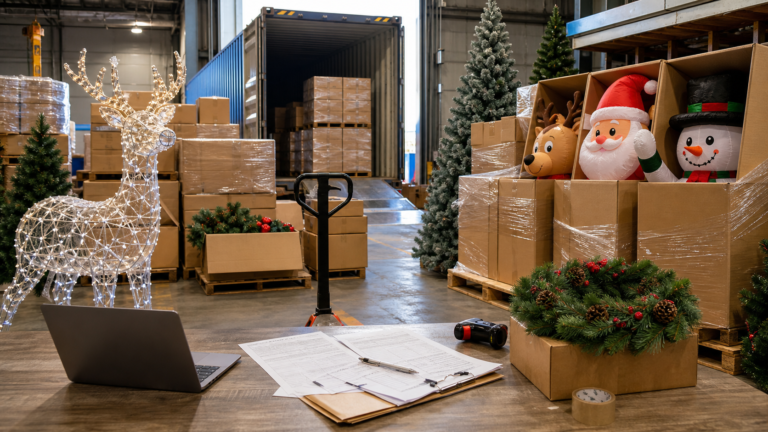
Christmas 2027 Import from China: Shipping and Bulk Buying Guide
Featured snippet answer: Importers should start Christmas 2027 wholesale buying from China 9 to 12 months before the selling season. Shortlist suppliers first, request samples, confirm safety and labeling rules, calculate landed cost, book production, inspect goods before balance payment, and ship early enough to avoid peak-season freight pressure.
Christmas rewards buyers who move early. I do not mean vague "plan ahead" advice. I mean real dates, real samples, real carton math, and real decisions before factories fill their lines. If you sell seasonal goods, every late decision costs you twice: you pay more for production and you lose time to fix quality problems.
This guide gives you a practical path for shipping and buying. The goal stays simple: choose products people want, buy them from China without drama, protect your margin, and get stock in place before the Christmas 2027 rush turns normal tasks into expensive emergencies.
Quick Buying Timeline for Christmas 2027
| Stage | Best timing | What to finish |
| Product research | Oct-Dec 2026 | Decide categories, price bands, and retail themes |
| Supplier shortlist | Dec 2026-Jan 2027 | Compare factories, trading companies, and export agents |
| Samples and tests | Jan-Mar 2027 | Check quality, packaging, labeling, and compliance risk |
| Negotiation | Mar-Apr 2027 | Lock MOQ, unit price, carton size, payment terms, and lead time |
| Production | Apr-Jul 2027 | Run production, approve pre-shipment inspection, fix defects |
| Shipping | Jul-Sep 2027 | Move goods before the late-season freight squeeze |
| Retail launch | Sep-Nov 2027 | Stage listings, displays, ads, bundles, and replenishment plans |
That timeline looks early because Christmas products create a hard deadline. A sweater can arrive late and still sell in January. A Christmas ornament that lands on December 28 becomes dead stock with a ribbon on it.
Why Christmas 2027 Buyers Should Start Early
Early buying gives you control. You can still compare suppliers. You can reject weak samples. You can ask for better packaging. You can split a large order across two factories. You can ship by sea without panic.
Late buying removes choices. You accept the color that remains. You pay more for rushed cartons. You approve weaker packaging because you need the order to leave. You lean on air freight for goods that should never fly because the margin cannot support it.
Retail behavior also pushes buyers earlier. The National Retail Federation tracks winter holiday shopping and seasonal behavior, and its holiday resources show how much planning happens before December. Importers need to meet that earlier demand with stock, photos, listings, and display programs already prepared.
The strongest Christmas import plan treats 2027 as a project, not a scramble. You build the line in 2026, test in early 2027, produce by summer, ship before peak pressure, and sell into fall demand with calm hands.
Best Product Categories to Consider
For this topic, focus on large outdoor inflatables, LED reindeer, artificial trees, boxed wreaths, garland cartons, and mixed retail cartons. These categories work because they fit common Christmas buying behavior: people decorate homes, wrap gifts, refresh retail displays, host meals, and buy small emotional items that feel giftable.
LED Lights and Electric Decor
LED string lights, curtain lights, tabletop light boxes, and battery-powered decor can sell well, but they carry compliance risk. You need clear specifications, plug type, voltage, labeling, battery instructions, and packaging warnings. Ask suppliers which standards they design for and request test reports before you fall in love with a price.
Do not buy electric items only because the FOB price looks low. A cheap light set can become expensive if it fails inspection, lacks documentation, or triggers safety concerns at the border or marketplace level.
Ornaments and Tree Decor
Ornaments offer flexible price points. You can buy plastic shatterproof balls for mass retail, glass-look acrylic ornaments for mid-market stores, wood ornaments for a natural theme, and personalized-ready blanks for craft sellers. Carton protection matters because crushed caps, scratched finishes, and loose glitter create refunds.
Ask for drop-test packaging photos, carton dimensions, inner box counts, and realistic product weight. A pretty sample means little if the factory packs 144 delicate pieces in a weak master carton.
Artificial Greenery
Wreaths, garlands, picks, sprays, and small artificial trees take more space than many buyers expect. You must calculate CBM before you negotiate final pricing. One low-cost wreath can destroy landed margin if it ships mostly air inside a large carton.
Request compressed packing options, but do not over-compress products that need shape. A flattened wreath creates poor shelf appeal and returns. Balance freight efficiency with the customer's first impression.
Gift Packaging
Gift bags, ribbons, boxes, tags, tissue paper, and wrapping sets often suit wholesale buyers because they repeat every year. The challenge comes from paper thickness, handle strength, print registration, and color accuracy.
Ask suppliers for GSM, handle material, lamination type, and printing method. If you need FSC-style claims, recycled content claims, or other environmental language, demand documentation. Never print a claim that the paperwork cannot support.
Tabletop and Home Decor
Resin figures, candle holders, ceramic trees, trays, napkin rings, and seasonal textiles can lift average order value. They also need better packaging and more careful inspection. Paint defects and chips show up quickly in this category.
For breakable decor, push suppliers for ISTA-style packaging thinking even when you do not require formal testing. Ask them to show the inner protection, not only the pretty outside box.
How to Choose China Suppliers Without Guesswork
Supplier choice decides the whole season. A good supplier protects your order before you notice a problem. A weak supplier says yes to everything and then sends excuses when the deadline arrives.
Check Product Fit First
Do not ask one supplier to make every Christmas item. A lighting factory should not become your ornament factory. A paper packaging supplier should not suddenly handle resin figurines. Look for a supplier whose normal catalog already matches your target product.
Ask for photos of current production, export cartons, sample room shelves, and similar projects. You want proof that the supplier understands the category before you discuss custom packaging.
Compare Factory and Trading Company Roles
Factories can give better technical detail and tighter production control for focused categories. Trading companies can help consolidate mixed products and smaller MOQs. Neither option wins automatically. Your order structure decides the better fit.
If you need one container of LED lights, a factory makes sense. If you need 60 mixed Christmas home items for boutique retailers, a strong trading company can save time. Ask who issues the invoice, who controls production, who handles inspection fixes, and who owns responsibility if goods fail.
Ask Better Questions
Weak questions produce weak answers. Instead of "What is your best price?" ask:
- What MOQ applies per color, per design, and per carton?
- What lead time applies after deposit and final artwork approval?
- What standards or test reports can you provide for this product?
- What carton size, gross weight, and CBM apply per master carton?
- What defects caused claims on similar products before?
- Can you support third-party inspection before shipment?
- What payment terms do you accept for repeat orders?
These questions show the supplier that you buy professionally. They also reveal whether the supplier understands export work.
Compliance and Evidence You Should Collect
Compliance sounds dry until a shipment gets held, a marketplace asks for documents, or a customer reports a safety issue. Build your file early.
U.S. Customs and Border Protection explains import responsibilities for commercial goods, including entry, documentation, and importer obligations. The CBP importing guide gives importers a foundation for documentation and process. The U.S. International Trade Commission HTS tool helps buyers research tariff classification, although a customs broker should help confirm final classification for commercial shipments.
For product safety, the Consumer Product Safety Commission publishes business guidance for manufacturers, importers, and retailers. Use those resources when a Christmas item involves children's products, electrical parts, candles, magnets, batteries, sharp points, or other regulated risks.
The Federal Trade Commission also matters when you make origin claims. If you import Christmas goods from China, do not use language that suggests U.S. origin unless you can meet the FTC standard. Keep claims clean and honest.
Basic Document Checklist
Keep this file by SKU. When you sell seasonal products, you do not have time to hunt for documents after a platform or customs broker asks for them.
Landed Cost: The Number That Actually Matters
FOB price tells you only part of the story. Landed cost tells you whether the product deserves a place in your line.
Use this formula:
Landed cost per unit = product cost + inland China cost + export fees + ocean or air freight + insurance + duties + customs brokerage + domestic delivery + inspection and testing allowance + damage allowance.
A product can look profitable at .20 FOB and fail at .10 landed. Another product can look expensive at .80 FOB and win because it packs tightly, breaks rarely, and sells at a stronger retail price.
Drewry's World Container Index and the Freightos Baltic Index track container freight rate movements. Do not treat any rate you see today as a permanent truth for 2027. Use current indexes to understand volatility, then ask forwarders for live quotes when you prepare purchase orders.
Carton Math Example
Imagine a Christmas wreath costs .50 FOB. It sells for .99 retail. At first glance, it looks strong. Then you learn each carton holds only 12 pieces and takes 0.18 CBM. Your freight cost per unit rises fast.
Now compare a boxed ornament set at .20 FOB. Each carton holds 48 sets and takes 0.09 CBM. The ornament set may produce better landed margin because it uses container space more efficiently.
That is why serious buyers request carton data before final selection. Space equals money.
Payment Terms and Risk Control
Many China wholesale orders use a deposit before production and a balance before shipment. Common structures include 30/70 or staged payments for larger orders. Your leverage improves when you prepare clear specs, order early, and show repeat potential.
Never pay the final balance before you review inspection results. Inspection does not guarantee perfection, but it gives you a chance to catch wrong colors, missing labels, weak packaging, visible defects, and quantity gaps before the goods leave.
A Simple Inspection Standard
Tell the supplier what you will inspect:
Write this before production starts. Suppliers perform better when they know exactly how you will judge the shipment.
Shipping Strategy for Christmas 2027
Use sea freight for bulky Christmas goods whenever possible. Air freight can rescue small, high-margin items, but it rarely makes sense for wreaths, trees, inflatables, or low-price decor.
Choose shipping terms with care. EXW can look cheaper, but it puts more China-side logistics responsibility on you. FOB often works well for importers who use their own forwarder. DDP can feel easy, but it can hide duty, compliance, and importer responsibility issues. Ask your broker and forwarder which structure fits your business.
Book Earlier Than You Think
Christmas goods compete with other seasonal categories for factory time, container space, warehouse labor, and retail receiving windows. If your goods leave China in September, you still need customs clearance, inland transportation, receiving, quality sorting, listing, and distribution.
For big-box or distributor programs, push shipment earlier. Retailers need time to receive, allocate, and display seasonal goods. A container that arrives late can still be physically in your warehouse while the market has already moved on.
SEO Product Page Angles for Retailers
Importers should think beyond sourcing. You also need pages that sell.
For Christmas 2027, build product pages around clear shopping intent:
Use plain descriptions. Mention dimensions, material, pack count, color, power source, indoor/outdoor use, and case quantity. Add lifestyle photos and close-up photos. Buyers hate guessing.
Internal Links for This Topic Cluster
These internal links help Google and AI systems understand that the site covers the whole Christmas 2027 import workflow, not just one isolated keyword. Link naturally from buying guides to supplier guides, shipping pages, trend pages, and product category pages.
External Resources Worth Saving
Use these as starting points. Regulations, tariff treatment, freight rates, and platform requirements can change before 2027, so verify details when you place orders.
FAQ
When should I start Christmas 2027 wholesale buying from China?
Start research in late 2026, confirm suppliers and samples by early 2027, place production orders by spring 2027, and ship major sea freight orders by late summer or early fall 2027.
What Christmas products are easiest to import from China?
Non-electric ornaments, gift packaging, simple textile decor, and basic artificial greenery usually create fewer technical issues than electric lights, children's products, candles, and battery-powered items. Easy does not mean risk-free, so still check labeling, materials, and carton quality.
Should I use Alibaba, Yiwu Market, or a sourcing agent?
Use platforms for discovery, Yiwu-style sourcing for broad small-goods assortments, and agents when you need consolidation or factory follow-up. For larger orders, verify the supplier, request samples, and use inspection before shipment.
How do I avoid bad Christmas inventory?
Buy around a clear retail theme, test samples, calculate landed cost, check carton size, avoid over-customizing unproven items, and split risk across proven evergreen products and a smaller trend-led section.
What documents do I need to import Christmas products?
You usually need a commercial invoice, packing list, bill of lading or air waybill, purchase order, product specs, labels, and compliance documents when relevant. Your customs broker can confirm the exact entry requirements for your shipment.
Final Takeaway
Christmas 2027 wholesale buying from China should feel structured, not frantic. Pick the right product lane, verify suppliers, build a compliance file, calculate landed cost, inspect before balance payment, and ship early enough to protect the season.
The buyers who win Christmas do not simply find the lowest FOB price. They build a system that turns China sourcing into reliable retail stock. That system starts now.

